Will Navidson–Delial relationship
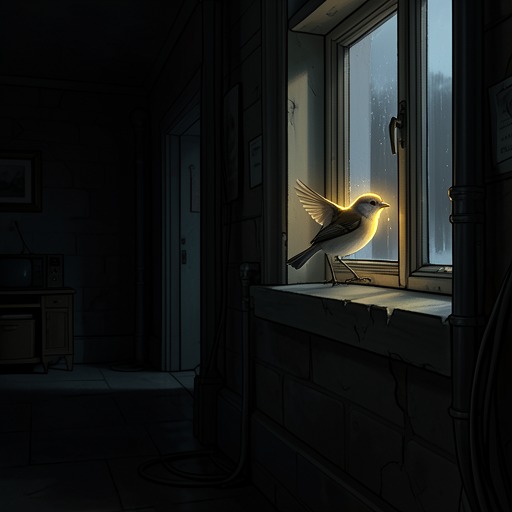
House of LeavesThe Will Navidson–Delial relationship begins with a photograph and develops into one of the deepest measures of Will Navidson’s moral and emotional life. Delial is the name Navidson gives to the starving Sudanese child in his Pulitzer Prize-winning image, but she is not merely a subject in his photographic archive: she becomes the figure through which he remembers what he saw, what he failed to do, and the person he believed himself to have been before the photograph was taken.
Identity and Discovery
Delial is a five-year-old Sudanese child depicted dying of starvation while a vulture waits behind her. The image became famous, yet Navidson kept the child’s identity secret for years. Karen Green first encounters the mystery indirectly, when Navidson repeatedly says Delial’s name in his sleep. He refuses to explain who she is, even though friends and fellow photojournalists have heard the name before. Some interpret it as a private romance or an invented mystery; none understands that it refers to the child in the photograph.
The secret is disclosed through Karen’s filmic account. She identifies the print as one from Navidson’s personal collection, the same photograph he kept in their home and placed among the first objects in the car when the family fled. After lingering on the image, Karen turns the print over and gradually brings six penciled letters into view: “Delial”. The revelation connects the private name in Navidson’s dreams and conversations to the public photograph that established his fame.
The Photograph and the Ethical Crisis
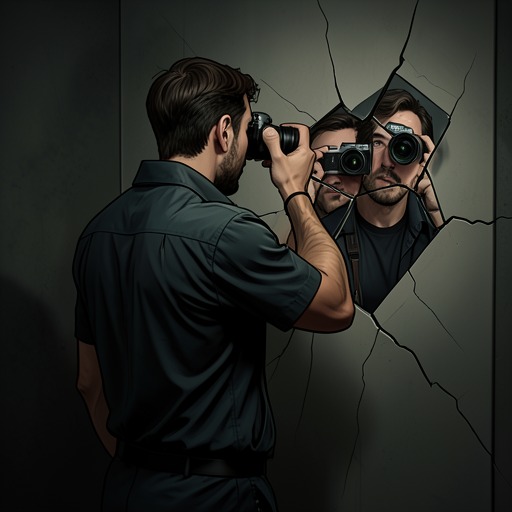
Navidson’s career is defined by an intense concentration on people rather than scenery. His photographs range across soldiers, peasants, children, medics, lepers, newlyweds, and families, presenting the world as meaningful because people endure, suffer, and sometimes triumph within it. Yet more than a third of his work records defeat: executions, bodies in ruins, and faces at the edge of death. Delial’s photograph therefore belongs to a larger practice in which Navidson repeatedly places himself before human mortality.
The image also exposes the contradiction at the center of that practice. Navidson photographs the child only once, choosing one arrangement from the countless possible combinations of angle, exposure, focus, framing, and light. The vulture stands behind her on the left, slightly out of focus, while Delial occupies the center in sharp focus, holding a bone. The entire right side of the frame remains apparently empty. Critics argue that this space is not empty at all: it represents Navidson’s unseen presence, making the photographer and the viewer participants in the scene rather than detached spectators.
Navidson later remembers that the real vulture was the photographer with the camera. He knows that the child may already have been close to death, but he also knows that he spent precious minutes making the photograph instead of taking her somewhere safe. The relationship is thus not founded on mutual recognition or sustained contact; it is created by an act of looking that preserves Delial as an image while leaving Navidson haunted by the possibility that looking displaced rescuing.
Secrecy, Guilt, and Repetition
Navidson’s silence turns Delial into a recurring private disturbance. Karen hears him speak the name twice in his sleep on a cold night in May, and he offers no explanation. Even Billy Reston, who had heard the name, never connected it with the photograph. Navidson answers questions with evasions such as “I forget,” “Someone close to me,” or “Allow a man a little mystery,” allowing the secret to remain suspended between intimacy and concealment.
His final letter to Karen breaks that concealment in a disordered rush of grief, alcohol, fear, and self-accusation. He says that Delial is the name he gave the girl in the photograph that won him fame, then insists that she is more than the photograph. He recalls the child as a little girl in a field of rock, holding a bone, and remembers that she died in his hands after he had taken the picture. The letter repeatedly returns to her name and to the question of the man he was before he encountered her—the man who, in his own retrospective judgment, would have saved her.
The letter also links Delial to Navidson’s other losses. He misses Karen, Daisy Navidson, Chad Navidson, and members of the expedition, but Delial cannot be placed safely among ordinary memories of family or friendship. Her presence is bound to an irreversible decision and to an image that made Navidson famous while preserving the evidence of his failure. His grief is therefore both personal and public: he mourns the child, condemns himself, and confronts the fact that the world consumed the photograph as an achievement.
Relation to the House and to Mortality
The Delial image prepares the ethical problem Navidson later encounters in The house on Ash Tree Lane. Throughout his career, he places another person between himself and death; he photographs danger through the presence of someone else. Returning to the house removes that intermediary. The dark space threatens no population and contains no other visible participant whose suffering can be recorded. It threatens Navidson himself, forcing him to confront a form of mortality that cannot be displaced onto another human subject.
This connection does not erase Delial’s historical specificity. The child remains a concrete victim of starvation, not merely an abstract symbol. At the same time, critical commentary observes that memory, experience, and time transform her into a figure for everything Navidson has lost. That transformation is ethically unstable. It allows Navidson to organize otherwise inexpressible grief, but it also risks making Delial serve as a vessel for his family losses, professional shame, and fear of death. The relationship consequently oscillates between recognition of a child’s suffering and appropriation of that suffering into Navidson’s private mythology.
Narrative and Ethical Significance
The Navidson Record presents Delial only once: as a bordered, frozen photograph without music or commentary. That restraint prevents the film from turning her into a sentimental spectacle, while the prolonged attention to the image and its reverse makes the act of viewing unavoidable. The scene reveals not only who Delial is, but how photographs can preserve suffering while concealing the conditions under which the suffering was observed.
Delial’s relationship with Navidson is therefore best understood as traumatic and ethical rather than romantic or conventional. She becomes the absent person whose face—or, more precisely, whose photographed body—continues to demand an answer from the man who recorded it. Navidson never escapes the tension between witnessing and intervention. His later work, his secrecy, his dreams, and his confrontation with the house all circle the same unresolved question: whether an image can constitute responsibility after the moment of possible rescue has already passed.